
Cloud Control

The biggest companies depend on Cisco. From networking, to security, to collaboration, to data center, to cloud, to AI, Cisco is the backbone of the modern enterprise.

Some background

[MY_TEAM_]

We were responsible for owning the entire landing experience. From day 0 to day 'n', this meant thinking about every type of user that could possible exist and what they would need to interact with to be successful.

We worked with product and engineering to ideate, come up with unique solutions, and build an experience that was not only functional, but also beautiful and intuitive.
2x Product designers
2x UI designers
1x Systems designer
1x User experience researcher
1x Design program manager

[PARTNERS_]

To pull off something this ambitious, we needed to work with other teams to get the job done. There were several other teams responsible for building and shipping other supporting experiences that would create the entire experience.
Navigation and IA
AI Canvas
Inventory and topology
Tenant and user management
User experience research

[XFN_]

And of course building something this huge requires massive support from the entire organization. From executive leadership to entire divisions, we needed everyone on board to help us succeed.
Executive leadership
Product management
Frontend engineering
Backend engineering

Our Objective


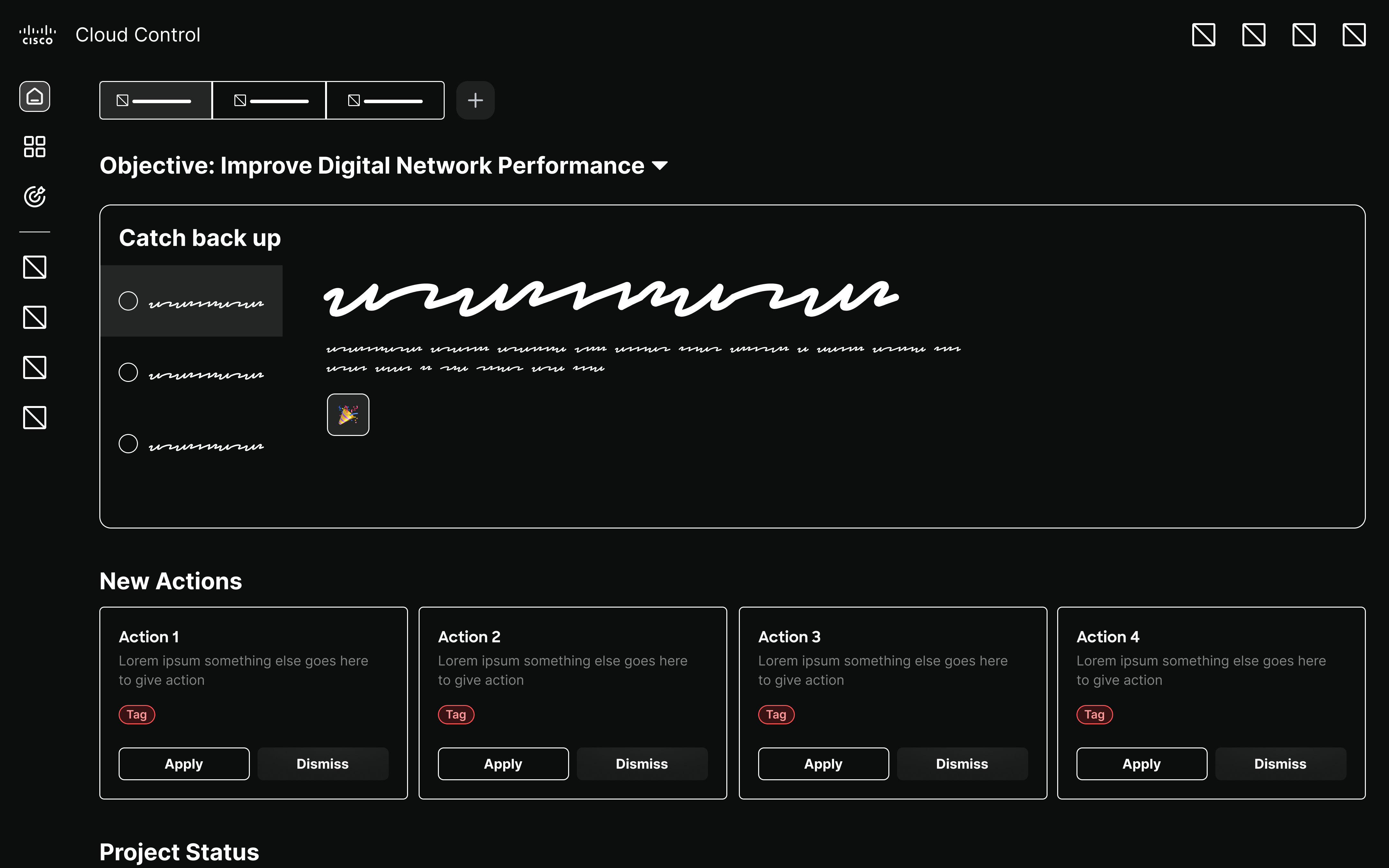
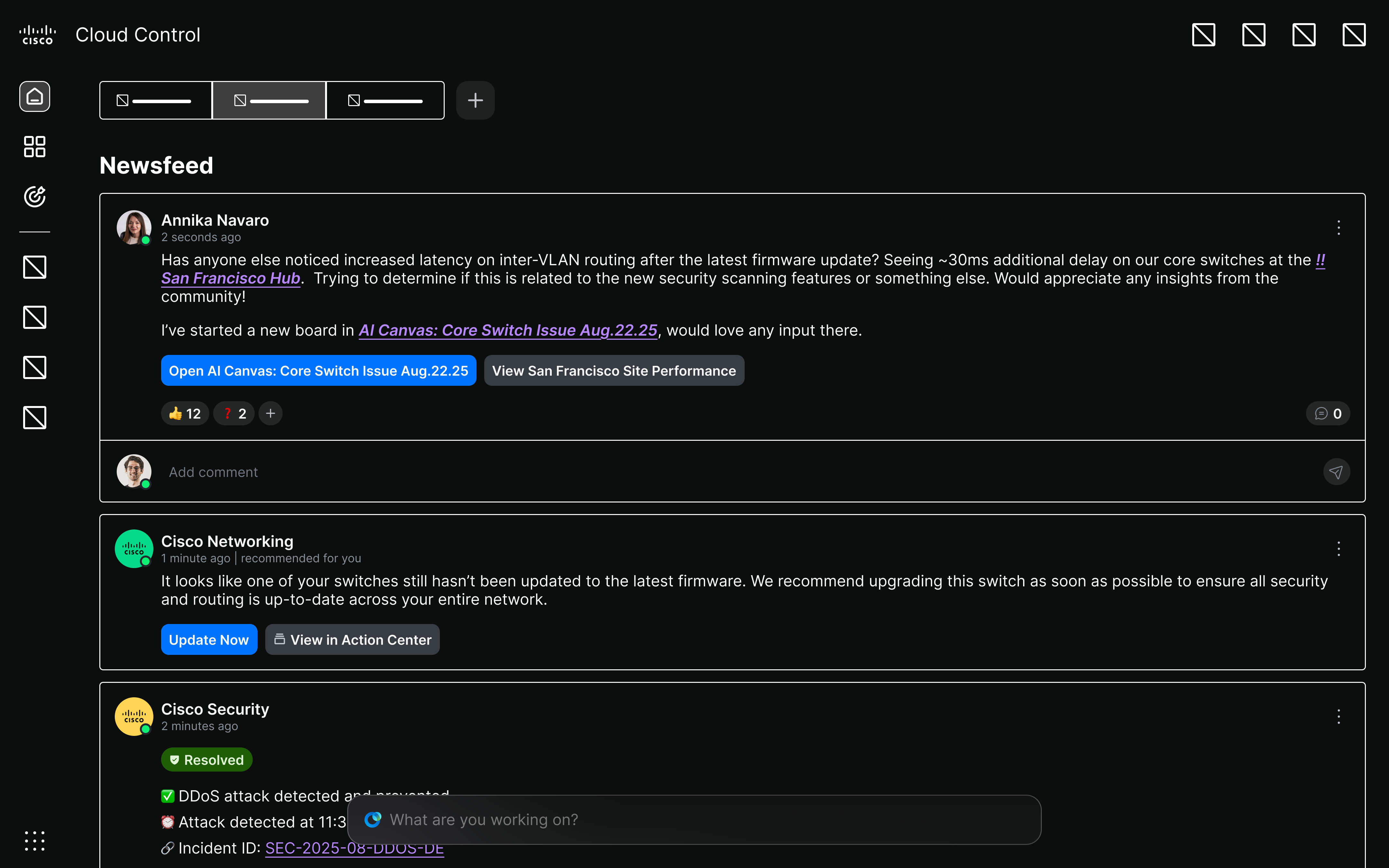
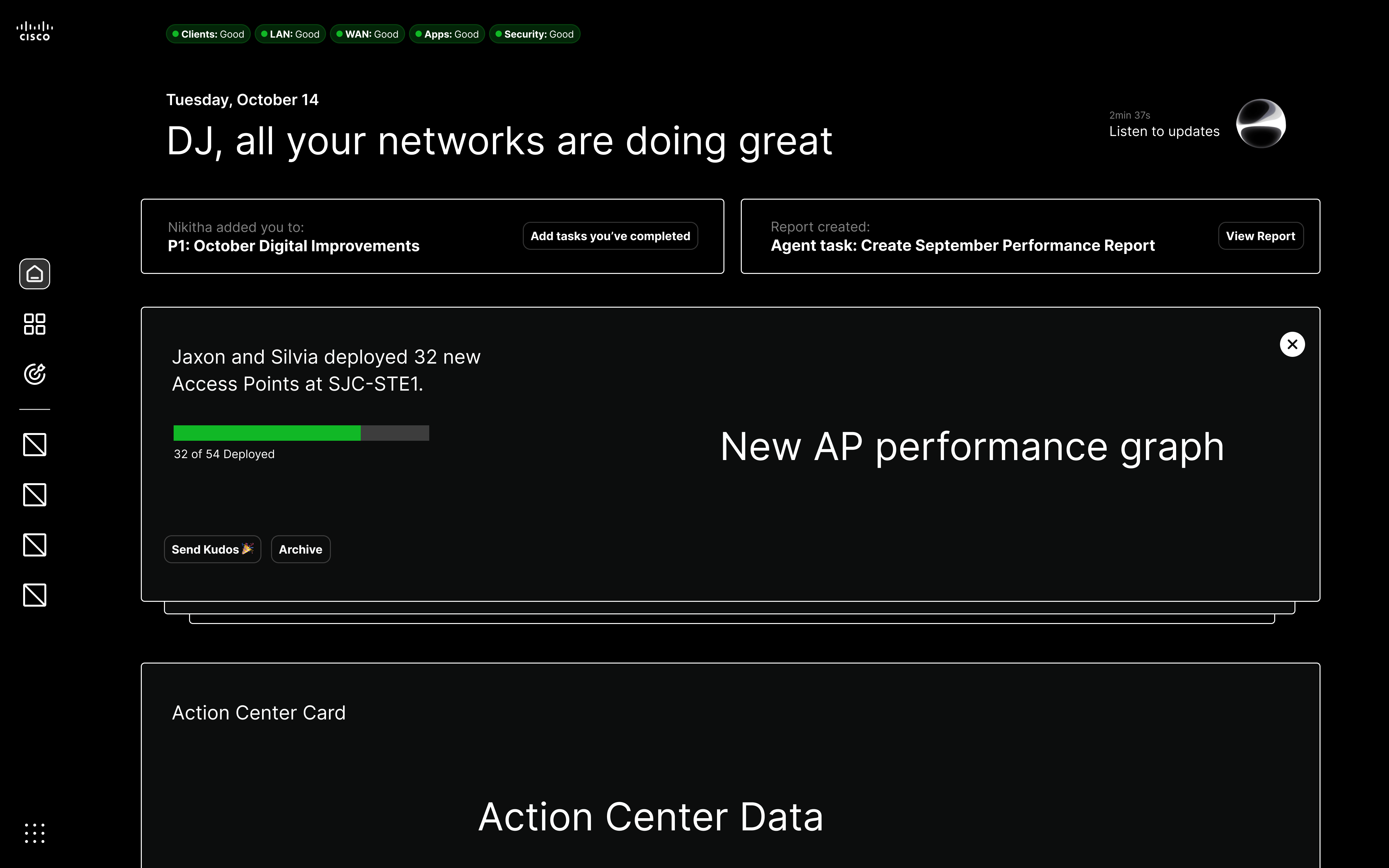
Design an [AI-forward] landing experience for [Cisco Cloud Control] that stitches together multiple Cisco offerings.

The problem

When we kicked off this project, shockingly nobody was aligned on what the experience should be. We had a few different ideas, but no clear direction. We needed to figure out what the experience should be and how it should work. The problem was so ambiguous and so undefinied. But where lies a problem, there lies an opportunity.

Finding clarity

To discover clarity, we needed to understand our users needs and what they were looking to accomplish. Throughout this project we ran over 20 customer interviews with some of our biggest customers to learn about their needs, pain points, and goals. It was an opportunity to better understand how they thought about AI and what they expected from Cisco as we enter into a new phase of experience. We then utilized these findings to tactically influence our direction.


Understanding our users needs

We know that stitching our products together solves a problem for our customers—too many dashboards, not one unified pane of glass. But we also knew that each user who lands on Cisco Cloud Control was looking to accomplish something specific.

  • Tier 1 wants to close tickets
  • Tier 2 wants to analyze performance
  • Tier 3 wants to build resiliency

Moving away from dashboards

Leaders wanted something bold, something immersive that would make users look at it and think "wow, this is something special." We needed to move away from the traditional dashboard and create an experience that was more engaging and more immersive.

  • Move users from insight to action
  • Help the user cut through noise
  • Introduce common AI paradigms

Striking balance

The reality of building an AI-first experience was that we needed to strike the right balance between providing users with the information they need to make decisions and not overwhelming them with too much information while still being able to provide opportunities for users to explore and discover new information.

  • Creating a scalable experience for Agentic AI
  • Don't overwhelm the user
  • ENABLE THEM TO DO THEIR JOB

The reality

I'd love to share more about this project, how we made decisions, and how I influcenced the direction of this work. If that seems interesting, feel free to reach out and we can chat about it.

But to share a little of the fun, we got some abnormally positive feedback from our users and executive leaders.